

Last updated: October 2026
If you have been shortlisted for the Asian Development Bank Young Professionals Program (ADB YPP) 2027, the ADB online assessment is the next step between you and the interviews. Your CV got you this far; this stage is about how you reason and judge under time pressure.
The good news: every component rewards preparation. This guide explains what candidates in recent cycles report about each test, walks you through four solved sample questions, shows the traps that cost points, and gives you a 14-day, 7-day and 48-hour plan you can start today.
What is the ADB online assessment?
ADB’s Young Professional posting describes a multi-stage selection process for shortlisted candidates: an online assessment, then a video interview in which you record answers to pre-set questions on your own schedule, and then panel interviews in the first quarter of 2027.
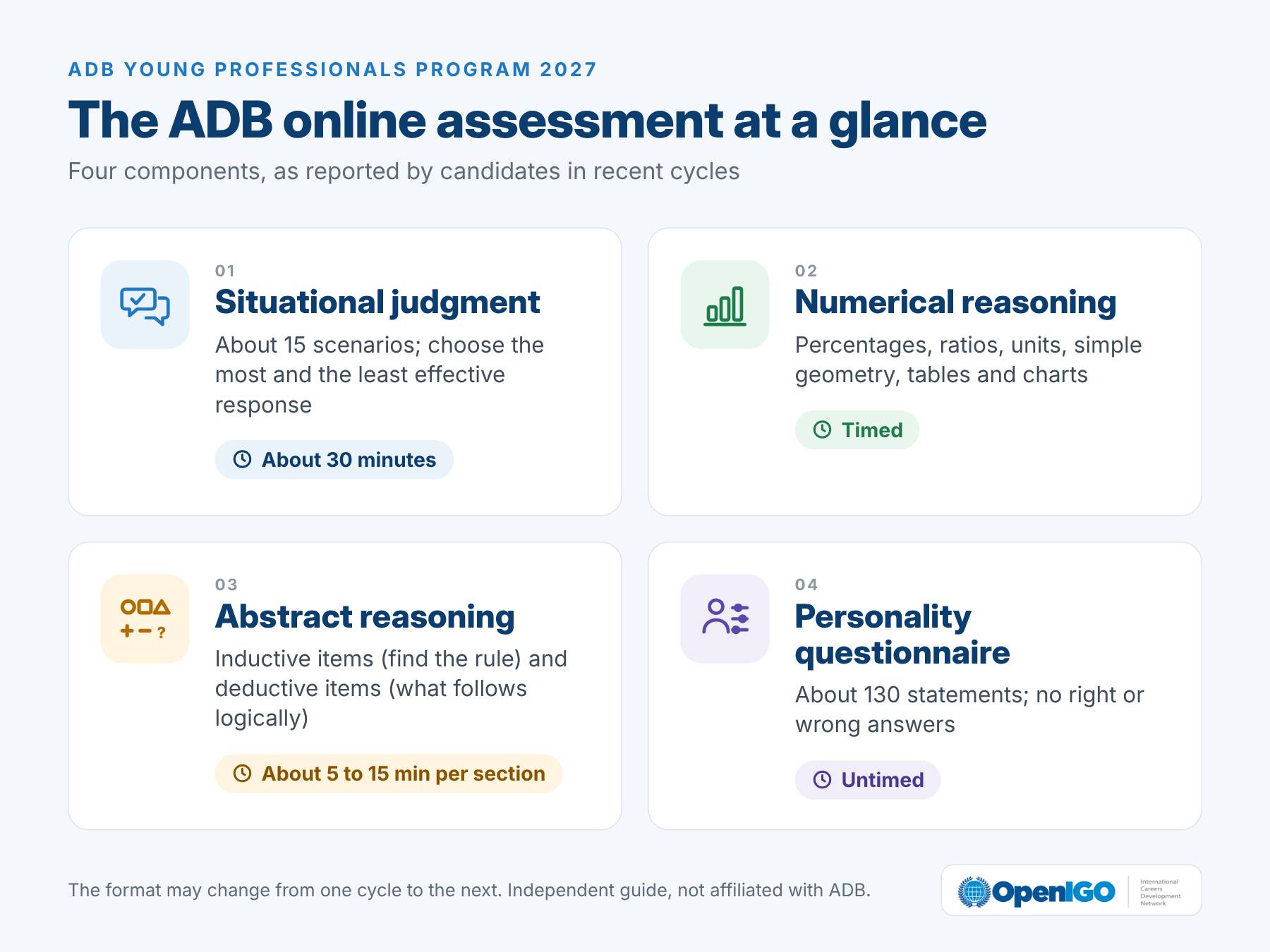
ADB does not publish the content of the online assessment, but candidates in recent cycles have consistently reported four psychometric components, completed remotely within a set window. The format can change, so read your invitation carefully. For how the tests were described in earlier cycles, see our earlier overview of the ADB’s online tests.
| Component | What it measures | Format reported by candidates | Time |
|---|---|---|---|
| Situational judgment test | Judgment in line with ADB’s values and competencies | About 15 scenarios, five responses each; pick the most and least effective | About 30 minutes |
| Numerical reasoning | Accuracy with percentages, ratios, units and data | Multiple choice, including tables and charts | Timed |
| Abstract reasoning | Finding rules and drawing valid conclusions | Figure sequences or matrices; logical statements | About 5 to 15 minutes per section |
| Personality questionnaire | Working preferences and style | About 130 statements | Untimed |
The situational judgment test: how ADB assesses your judgment
 The ADB situational judgment test places you in situations a Young Professional could face: a client request, a team disagreement, a tight deadline, an integrity issue or a safeguards concern. For each one, you choose the most and the least effective of five responses.
Effective responses reflect ADB’s values (client-centric, trustworthy, transformational) and its core competencies: Lead with Courage, Navigate Complexity, Grow Oneself and Others, Collaborate beyond Boundaries, and Drive Innovative Solutions. In practice, the best responses act early, address the issue directly, involve the right people, keep relationships constructive and stay within the rules.
Four traps to watch for
- Passivity. Waiting, ignoring the problem or deciding “it’s not my role”.
- Escalating too early. Going to the director before talking to the person involved.
- Overpromising. Committing ADB to something you cannot guarantee.
- Bypassing rules. Shortcuts on confidentiality, procurement or safeguards, even with good intentions.
When you look for the least effective response, remember that several options may be acceptable. The worst one usually breaks a rule, hides information or damages trust.
Solved example 1: situational judgment
On a site visit, villagers say their resettlement compensation has not been paid. What is the most effective response?
- Assure them that ADB will ensure they are paid next month
- Explain that compensation is the government’s job
- Record the details, verify them and alert the safeguards team
- Raise it informally with the contractor on site
Answer: C. Unpaid resettlement compensation is a serious safeguard issue. Document it, check it and bring in the safeguards specialists so it is handled through the project’s grievance and supervision arrangements. Promising payment overcommits ADB, deflecting ignores ADB’s oversight role, and the contractor is not the right channel.
In the real test you also choose the least effective response, so practice judging every option, not only the best one.
Numerical reasoning: the traps that cost points
The ADB numerical reasoning test covers percentages, ratios and proportion (the rule of three), units, simple geometry, and tables and charts. The arithmetic is rarely hard; the pressure comes from the clock, and the wrong options are built from predictable slips.
The five most common traps
- The wrong base. Percentage change always divides by the starting value, never by the new one.
- Percentage points versus percent. A rate that moves from 72% to 81% rises by 9 percentage points, which is a 12.5% relative increase.
- Simple versus compound growth. Growth of 5% a year for two years is 10.25% in total, not 10%.
- Simple versus weighted averages. A $100 million loan at 2% and a $300 million loan at 4% average 3.5%, not 3%.
- Units. Convert kilometers, meters, hectares and currencies before you calculate, not after.
A quick estimate lets you reject absurd options in seconds. Check your invitation to see whether a calculator is permitted.
Solved example 2: numerical reasoning
The poverty rate fell from 24% to 18%. By what percentage did the poverty rate fall?
- 6%
- 25%
- 33.3%
- 75%
Answer: B. The rate fell by 6 percentage points, which is 6 / 24 = 25% of its original level. “6%” confuses percentage points with percentage change, and 33.3% divides by the new value (6 / 18).
Abstract reasoning: inductive and deductive
The ADB abstract reasoning test has two families of items: inductive (find the rule in a sequence or matrix) and deductive (what follows logically from given statements). Both reward method more than inspiration.
Inductive reasoning: name the rule first
Work through the usual rule types in order:
- Differences between terms, and how they change.
- Ratios, such as doubling or dividing by three.
- Alternating patterns, where two rules or series take turns.
- Positions, for letters (A = 1 … Z = 26).
The real test mostly uses figures, but the method is the same: what changes, by how much, and in what cycle? Name the rule before you look at the options, so the distractors cannot lead you.
Solved example 3: inductive reasoning
What comes next? A, C, F, J, O, …
- T
- U
- S
- V
Answer: B. The gaps grow by one letter each time (+2, +3, +4, +5), so the next is +6: O is the 15th letter and the 21st is U.
Deductive reasoning: use only what you are given
Deductive items test logic, not knowledge of the world. Learn the valid forms and the classic fallacies:
- Valid: “If P, then Q. P is true, so Q is true.” “If P, then Q. Q is false, so P is false.” “Either A or B. Not A, so B.”
- Invalid: “If P, then Q. Q is true, so P is true” (affirming the consequent). “If P, then Q. P is false, so Q is false” (denying the antecedent).
For ordering and seating puzzles, sketch a line or grid before choosing.
Solved example 4: deductive reasoning
If it rains, the site visit is canceled. The site visit was canceled. What follows?
- It rained
- It did not rain
- The visit will be rescheduled
- It may or may not have rained
Answer: D. Concluding “it rained” is the classic fallacy of affirming the consequent: the visit could have been canceled for another reason.
The personality questionnaire: why honesty and consistency win
The ADB personality questionnaire is the only component with no time limit. Candidates report around 130 statements about how you prefer to work, and there are no right or wrong answers.
It still matters. Questionnaires like this typically show how your working preferences fit the role, and they often include consistency checks. Guessing the “ideal” candidate produces contradictory answers, and always choosing the middle option says little about you.
Answer as you actually behave at work, and take your time: there is no clock.
Just got your invitation? 14-day, 7-day and 48-hour prep plans
Wondering how to prepare for the ADB online assessment in the time you have? Three principles make any plan work: diagnose first with a short timed set, practice actively with a timer and an error log, and finish early in the window so a technical problem does not become a crisis.
14-day plan (60 to 120 minutes a day)
| Days | Focus | Output |
|---|---|---|
| 1 | Read the invitation; short timed diagnostic on all three tests | Your three main gaps |
| 2–3 | ADB’s mission, priorities, values and competencies | One-page summary |
| 4 | Situational judgment method and half of your scenarios | Choices justified in writing |
| 5–6 | Numerical reasoning, then timed data sets | Error log |
| 7 | Abstract reasoning and the personality questionnaire | Rule-type checklist |
| 8 | Remaining scenarios and a mixed timed set | Assessment taken if the window is open |
| 9–13 | Video interview: introduction, motivation, story bank, recorded practice | Answers reviewed |
| 14 | Equipment check, light review and rest | Ready for the next stage |
The second week turns to the video interview, which usually follows soon after. Our step-by-step guide to the ADB YPP interview covers the questions to expect.
7-day plan
- Day 1: Diagnostic and ADB essentials.
- Day 2: Situational judgment.
- Day 3: Numerical reasoning with a timer.
- Day 4: Abstract reasoning and personality; take the assessment if your window is open.
- Days 5–6: Video interview practice, recorded and reviewed.
- Day 7: Equipment check, light review and rest.
48-hour plan
- Day 1: Situational judgment principles and as many scenarios as you can, then the numerical traps and one timed set.
- Day 2: A second numerical set and a round of abstract items. Prepare your room and equipment, rest, and take the tests when you are fresh.
If you want these plans in full, with practice sets mapped to each day, they are part of the ADB online assessment manual and timed practice described below.
Common mistakes on test day
- Technical surprises. Use a computer rather than a phone, check your browser and connection, plug in your laptop and silence notifications.
- The wrong environment. Choose a quiet room and block the time.
- Getting stuck. Unless wrong answers are penalized, make an educated guess and move on; you may not be able to go back.
- Outside help. It breaches the rules and misrepresents your ability.
- Waiting for the last day. A power cut on the final day leaves no room to recover.
How OpenIGO can help you prepare
Preparing for the ADB online assessment comes down to structured, timed practice and understanding why an answer is right. OpenIGO offers two self-study options for the ADB Young Professionals Program 2027 built around that idea. The four sample questions in this article come from the same 150-question bank.
| Option | What’s included | Best for |
|---|---|---|
| ADB online assessment manual and timed practice | Seven-part Preparation Manual (18 readiness cards by area of expertise; 14-day, 7-day and 48-hour plans; video interview preparation), Online Timed Practice System with 150 original questions (50 situational judgment and strategy, 50 numerical, 50 abstract), and a Detailed Answer Key explaining every answer | Candidates who want timed practice and the reasoning behind each answer |
| Complete ADB online assessment package | Everything above, plus the eBook ADB YPP: The Essential Guide (2026 edition, 11 chapters on the program, ADB, development thinking and interviews) | Candidates who also want institutional depth for the interviews |
OpenIGO is independent and is not affiliated with or endorsed by the Asian Development Bank. Our practice questions are original and are not official ADB test items.
FAQ
Is the ADB online assessment timed?
Mostly, yes. Candidates report about 30 minutes for the situational judgment test and abstract reasoning sections of about 5 to 15 minutes, and the numerical test is also timed. The personality questionnaire has no time limit. Check your invitation, because timing can change from one cycle to the next.
How many scenarios are in the ADB situational judgment test?
Candidates in recent cycles report about 15 scenarios, each described in 10 to 12 sentences and followed by five possible responses. For each scenario you choose the most effective and the least effective response. ADB does not publish the format, so treat these numbers as a guide rather than a rule.
Is there a right answer in the personality questionnaire?
No. Candidates report around 130 statements about how you prefer to work, with no right or wrong answers and no time limit. Answer honestly and consistently, as you actually behave at work. Trying to guess an ideal profile tends to produce contradictory answers that weaken your result.
What comes after the online assessment?
According to ADB’s Young Professional posting, the next stage is a video interview in which you record answers to pre-set questions on your own schedule. Candidates who progress are invited to panel interviews in the first quarter of 2027. Prepare for the video interview in parallel, because it usually follows soon after.
How long should I prepare?
Ideally, start when you submit your application. A focused two weeks, at 60 to 120 minutes a day, lets you cover every component and start on the video interview. If your invitation leaves less time, use the 7-day or 48-hour plan and prioritize situational judgment, then numerical accuracy, then abstract rule types.
Are OpenIGO practice questions real ADB questions?
No. OpenIGO’s questions are original and written independently to reflect the styles of question that candidates report. They are not official or confidential ADB test items, and OpenIGO is not affiliated with or endorsed by the Asian Development Bank. Their value lies in practice and in the explanations behind each answer.
Final thoughts
The ADB online assessment does not test how much you know. It tests whether you judge situations the way ADB expects and reason accurately under time pressure, and both can be trained in a few weeks. Learn the logic of the situational judgment key, practice the traps with a timer, answer the personality questionnaire honestly, and test early in your window.
For a structured routine with 150 timed questions and explained answers, start with the ADB online assessment manual and timed practice, or choose the complete ADB online assessment package if you also want the institutional depth for the interviews ahead.